
Industry Insights
Iqbal Day 2026: Thoughtful Work in an AI Age
An Iqbal Day reflection on careful reading, independent judgment and responsible AI-assisted property marketing, with a practical review checklist.
Iqbal Day can be a useful moment to slow down, read carefully and take responsibility for what we create. On 9 November 2026, Pakistan marks the 149th birth anniversary of Allama Muhammad Iqbal. For people working with digital content and property media, a meaningful tribute can include a practical commitment: check the source, explain what you changed and review the result before publishing.
This is a contemporary reflection by EstateAI, a Pixel Perfects Solutions product. It does not claim that Iqbal wrote about artificial intelligence, property photography or modern software. The connection to our work is an editorial exercise, not a historical quotation or endorsement.
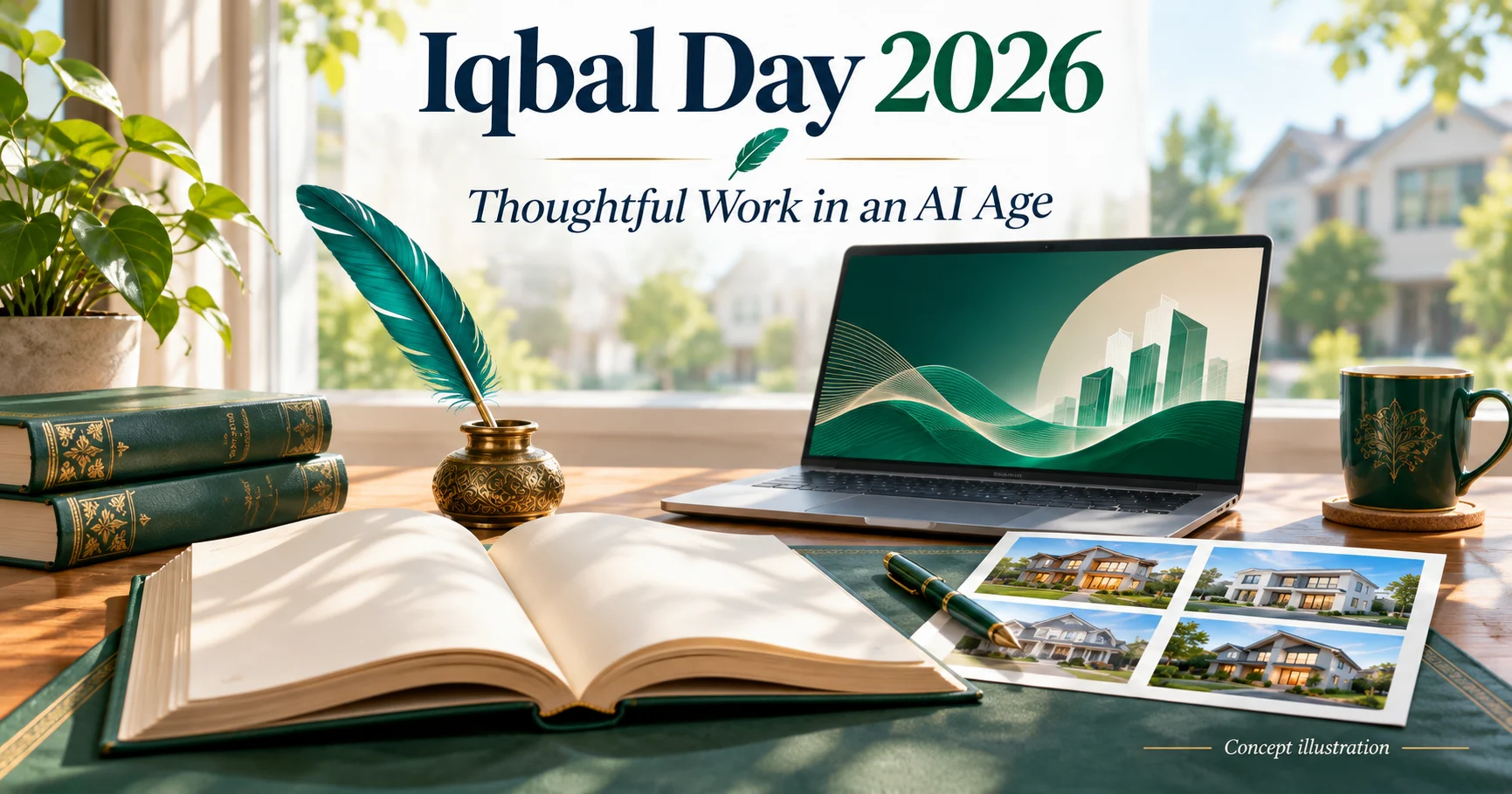
Cover: original AI-generated concept illustration of a literary and digital workspace. It is not a historical photograph, an EstateAI interface or an example of a real client property.
Iqbal Day begins with the person behind the portrait
Radio Pakistan’s report for 9 November 2026 identifies Iqbal as Pakistan’s national poet and records his birth in Sialkot on 9 November 1877. Remembering that history should come before turning the occasion into a marketing theme.
A commemorative image can introduce a reader to Iqbal, but a complete text offers more than a slogan. Choose a poem or passage from a traceable edition. Record the work, the language and, when applicable, the translator. Read the surrounding section before deciding what the words mean to you. If a striking quotation cannot be traced, leave it out and write a clearly identified reflection in your own words.
Keep source, interpretation and creation separate
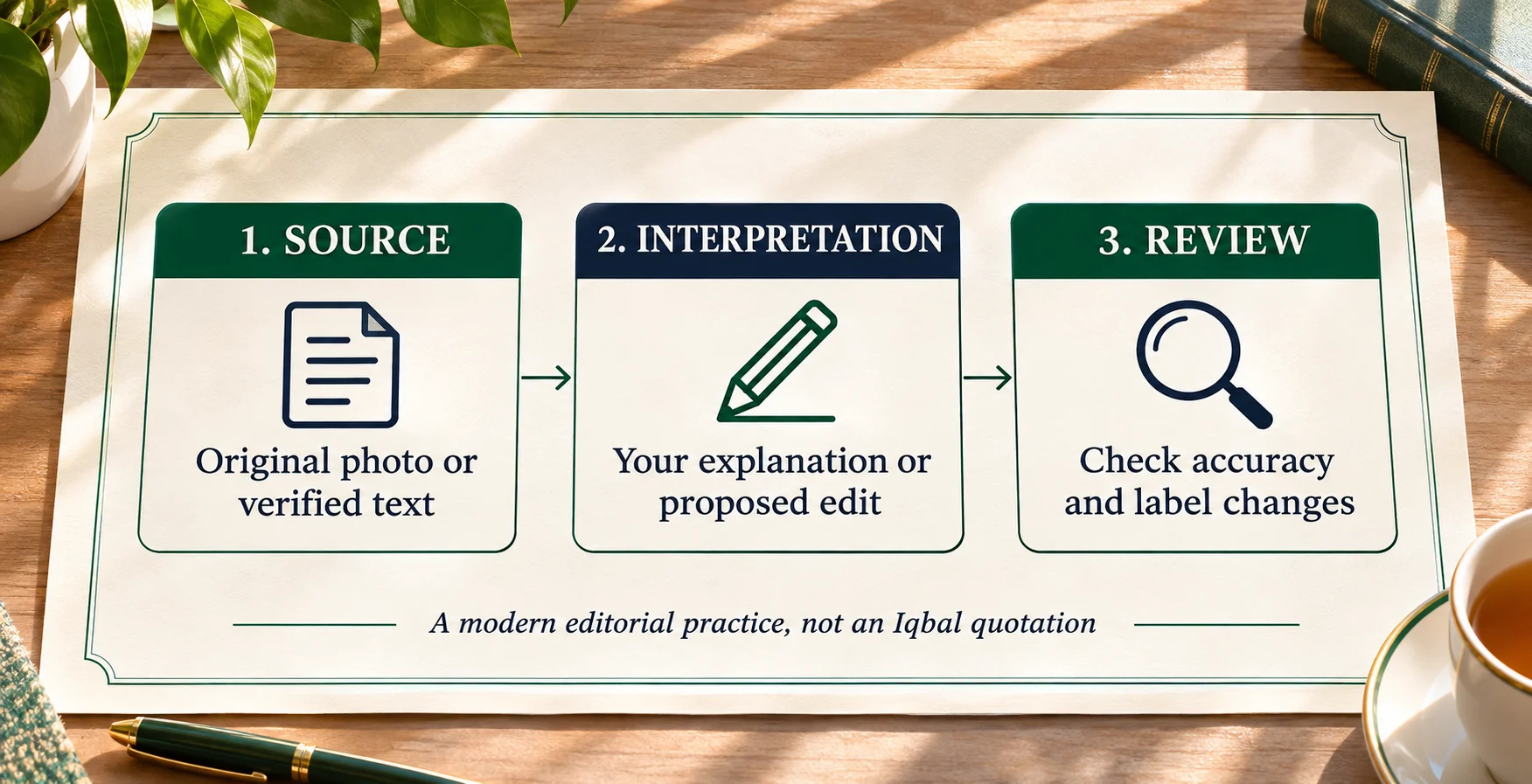
A useful reading practice separates three things: what a source says, how a reader understands it and what the reader decides to do next. The same distinction can help us think more clearly about property-media work.
In a reading note, the source may be a passage from a book. Your interpretation belongs in a separate paragraph. In property marketing, the source is the original photograph and the verified information about the property. A proposed visual edit is another layer. Keeping these layers distinct helps a colleague understand the work without guessing which parts document reality and which parts illustrate a possibility.
For example, adding furniture to an empty room illustrates one possible arrangement. It does not establish the furniture included in a sale. A renovation concept illustrates a proposed finish; it is not evidence that the work has been completed. These are practical distinctions for today’s creators, not ideas attributed to Iqbal.
Give judgment a clear place in the workflow
An attractive output is a starting point for review. Before sharing a property image, compare it with its source. Look at the room’s boundaries, window positions, permanent fixtures, reflections and proportions. Ask whether the edited version could leave a viewer with a materially different understanding of the photographed space.
Write a short review note that another person can follow. Instead of simply saying that an image looks better, explain the intended change and any unresolved question. For example: exposure adjusted, original structure retained, staged furniture added, final disclosure to be checked by the listing team. Do not call an image approved while those checks remain open.
Our AI real estate photo editing quality control checklist provides a related place to start. The useful habit is to make the review visible, rather than assuming that a finished-looking image has already been checked.
A small Iqbal Day exercise for a creative team
- Read: Spend ten minutes with a complete, traceable passage. Record its source and any translation details.
- Reflect: Write one question the reading raises for you. Keep your response separate from quoted words.
- Inspect: Choose one piece of work from your own workflow. Identify its original source, the edits or interpretations, and the decisions still requiring review.
- Improve: Make one concrete improvement: add a source link, correct an uncertain caption, label a concept image or document an approval step.
This exercise does not promise a productivity breakthrough. Its value is modest and practical: one clearer piece of work, with fewer assumptions left for the next reader or reviewer.
Make truthful captions part of the deliverable
Captions should explain what viewers are seeing. Alt text should describe the meaningful visual information for someone who cannot see it. Neither field should be packed with unrelated search terms. A useful caption might identify a virtual staging concept, while the alt text describes the room and the visible furniture arrangement. Keep any required disclosure easy to find.
For this article, the cover and supporting diagram are original AI-generated illustrations. They do not show Iqbal’s personal belongings, historical events, a real listing or tested EstateAI output. That distinction matters even when an image is only decorative.
Teams choosing between different edits can also consult our room-by-room guide to virtual decluttering and virtual staging. Select the treatment that fits the task, then check the result and the destination’s current publication requirements.
Carry the attention beyond one day
A respectful Iqbal Day tribute does not need an invented quotation, a claim about what Iqbal would think of AI or a sales promise. It can begin with reading his work and continue through a more careful approach to our own.
For a developer, that might mean documenting a decision. For a creator, it might mean tracing an attribution. For a property-media team, it might mean keeping the original photograph, proposed edit and final approval clearly connected. These are present-day choices we can make and evaluate on their own merits.
Today’s practical question: what is one thing you can make clearer for the next person who reads, reviews or relies on your work?