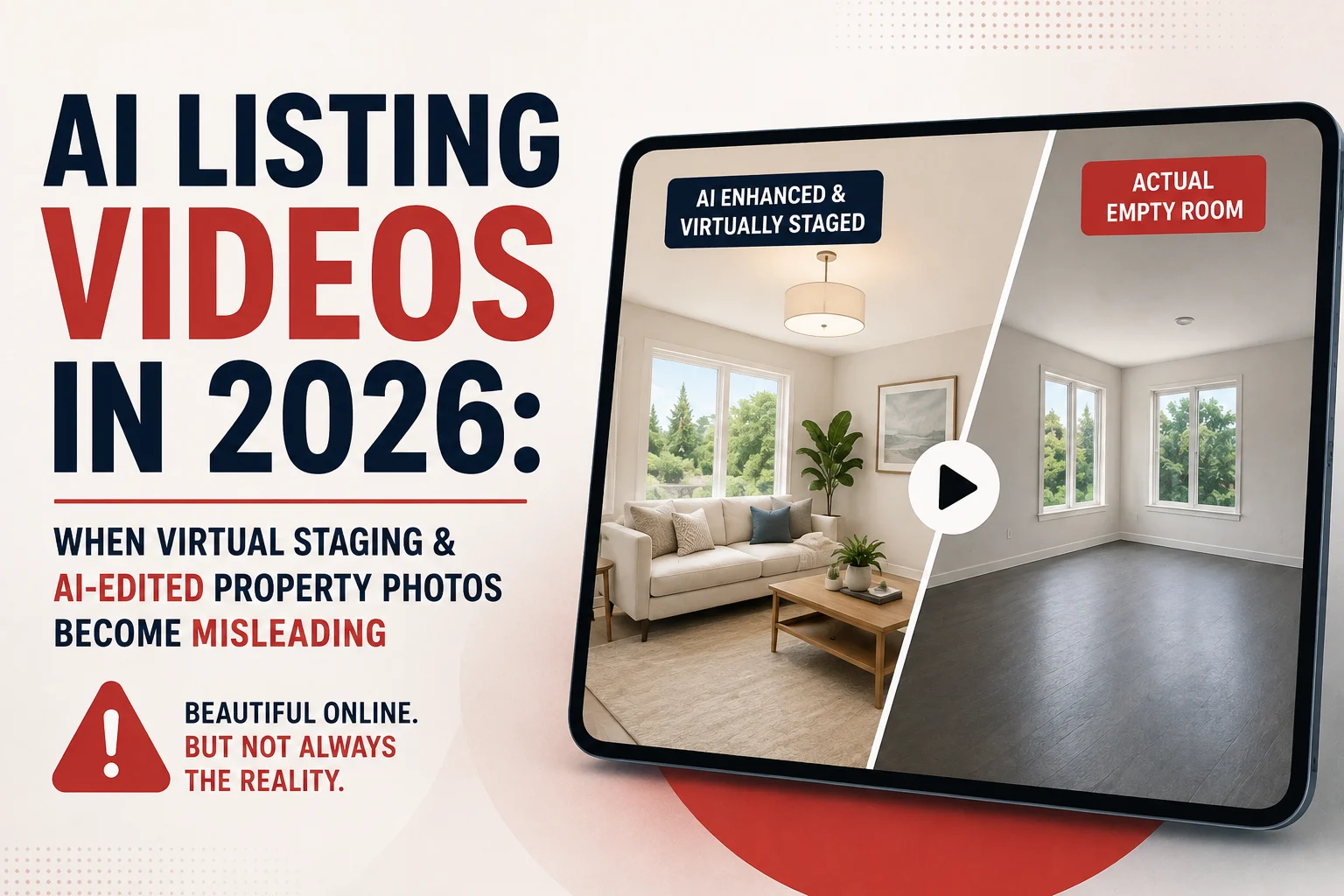
AI Listing Videos in 2026: When Virtual Staging & AI-Edited Property Photos Become Misleading | Estate Ai by Pixel Perfects Solutions
AI listing videos are changing real estate marketing in 2026—but what happens when AI invents windows, walls, layouts, or property features that do not exist? Explore the risks of AI-generated real estate videos, virtual staging accuracy, AI-edited listing photos, Zillow Showcase video requirements, disclosure, architecture preservation, and how agents and photographers can build more accurate, transparent property-media workflows.
EstateAI Editorial TeamSeptember 1, 202618 min readShare
Artificial intelligence is changing real estate marketing faster than almost any other part of the property-media workflow.
AI can now enhance listing photographs, furnish vacant rooms, remove visual clutter, create twilight-style exteriors, visualise renovations, and even turn a collection of still property photographs into an animated listing video.
For real estate agents, photographers, brokerages, and property marketing teams, these tools can dramatically reduce production time.
But they also introduce a new problem:
What happens when an AI-generated property video shows something that does not actually exist?
A virtually staged sofa is one thing.
An extra window, a larger room, a missing wall, an invented fireplace, or an AI-generated camera movement that makes the property appear structurally different is something else entirely.
As AI listing videos become more realistic in 2026, the difference between better property marketing and property misrepresentation is becoming increasingly important.
This is why the next stage of AI real estate marketing cannot be about generation alone.
It needs to be about accuracy, architecture preservation, transparency, human review, and responsible property-media workflows.
What Is an AI Listing Video?
An AI listing video is a property-marketing video created or assisted by artificial intelligence.
Instead of filming every sequence traditionally, AI systems may use existing property photographs, virtually staged images, floor plans, text, or other listing media to create video content.
Choose the right treatment for each listing photo: keep existing furniture, remove temporary clutter or stage a vacant room. Learn what to verify before delivery.
The launch of PropertyAdvice.ai's no-login, no-subscription AI-driven virtual staging platform signals a significant shift in how real estate marketing teams and photographers approach virtual staging. This article explores practical impacts for agents, photographers, builders, and marketing teams, highlighting streamlined workflows, greater accessibility, and integration potential with platforms like EstateAI.
Discover how the recent launch of PropLens, an AI-powered camera and staging app, is shaping a new era in virtual staging. Learn practical workflows, integration tips, and how to leverage AI-driven enhancements effectively alongside EstateAI’s comprehensive real estate marketing platform.
AI Listing Videos in 2026: When Virtual Staging & AI-Ed…
A Better Workflow for AI-Generated Property Media›
For real estate professionals, the appeal is obvious.
A photographer may already have 30, 40, or 50 photographs from a property shoot.
If those existing assets can be transformed into additional video content, the same property-media library becomes more useful across listing portals, brokerage websites, social media, email marketing, and advertising campaigns.
But there is an important distinction:
Animating a real property photograph does not automatically guarantee an accurate representation of the property.
That is where quality control becomes essential.
Why AI Listing Videos Are Becoming Important in 2026
Real estate marketing is no longer built around a single listing photograph.
A modern property campaign may include:
Professional photography
Image enhancement
Virtual staging
Floor plans
3D tours
Listing videos
Vertical social videos
Day-to-Dusk images
Drone photography
Interactive property experiences
Major real estate platforms are increasingly investing in richer listing media.
Zillow Showcase, for example, supports professional property imagery, interactive floor plans, 3D experiences, AI-assisted photo selection, Virtual Staging, and listing video.
This broader shift matters.
The question for agents and photographers is no longer simply:
"Do I need good listing photos?"
It is becoming:
"How do I turn one property shoot into a complete library of accurate, professional marketing media?"
That is a much larger workflow problem.
The Hidden Risk of AI Photo-to-Video Generation
A still photograph provides a fixed view of a property.
The viewer sees exactly what the camera captured from one position.
AI video generation can introduce something different: movement between visual states.
An AI system may attempt to create frames that were never photographed.
For general creative content, this can be impressive.
For real estate, it can be risky.
Imagine an original photograph showing a living room with two windows.
An AI-generated video attempts to simulate a camera movement across the room.
During the generated movement, the model temporarily creates a third window.
Or it changes the width of a doorway.
Or furniture passes incorrectly through a wall.
Or the apparent room dimensions expand as the virtual camera moves.
The final video may still look realistic.
But realistic does not necessarily mean accurate.
In real estate, visual realism and property truth are not the same thing.
Virtual Staging Is Not the Same as Changing the Property
This distinction is fundamental.
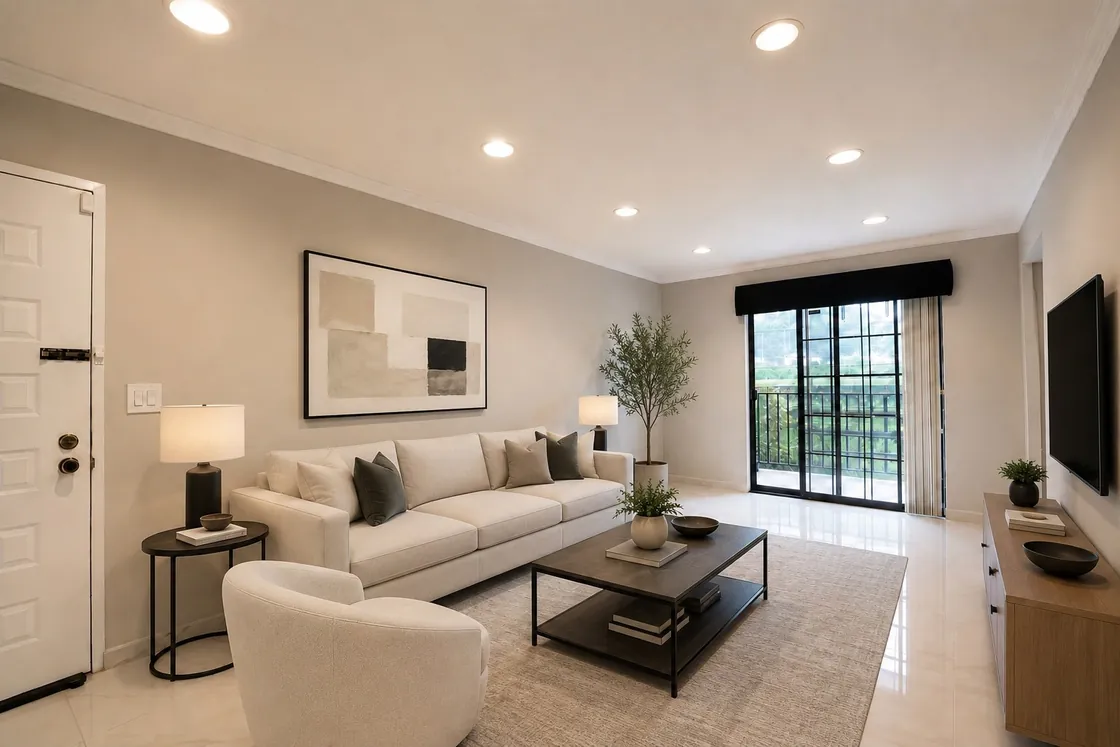
AI Virtual Staging is intended to help buyers visualise how a vacant space might look when furnished.
The transformation may introduce:
Sofas
Beds
Dining tables
Chairs
Rugs
Lamps
Artwork
Decorative accessories
But the underlying property should remain recognisable.
Important characteristics generally include:
Walls
Windows
Doors
Flooring
Ceilings
Permanent fixtures
Built-in features
Room proportions
Camera perspective
A virtually staged bedroom can show a bed.
It should not quietly invent another window because the AI thinks the room looks better with one.
That distinction becomes even more important when the staged image is later used as source material for an AI listing video.
AI Enhancement Is Different From Virtual Staging
Not every AI-edited property photograph represents the same type of modification.
These changes are fundamentally different from adjusting exposure or showing temporary virtual furniture.
A useful principle is:
Improve how buyers understand the property without changing what the property actually is.
AI Listing Video Accuracy Starts With the Source Photos
One of the most overlooked parts of AI video generation is the quality of the source imagery.
If an AI video is created from listing photographs, those photographs become the foundation of the generated result.
Poor source images can create problems such as:
Unclear room geometry
Incorrect perspective
Dark architectural details
Missing information around doors and windows
Distorted verticals
Inconsistent colours
Confusing room relationships
Strong real estate photography gives AI systems better visual information.
Before property images move into downstream video production, they should ideally have:
Straight verticals
Clear perspective
Balanced exposure
Natural colour
Visible architectural details
Consistent editing
Appropriate resolution
Useful room coverage
This is one reason professional image preparation remains important even as AI becomes more capable.
A Better Workflow for AI-Generated Property Media
AI should not turn real estate marketing into a one-click publishing process.
A stronger workflow keeps the original media, AI transformations, and human approval connected.
A professional process can look like this:
Original Photography → Image Enhancement → Appropriate AI Service → Compare With Original → Human Review → Approved Media → Video / MLS / Zillow / Social Marketing
Each stage has a purpose.
1. Start With Original Property Photography
Maintain the original photographs as the source record.
Do not permanently replace them with generated versions.
2. Improve the Photography
Apply appropriate corrections to exposure, colour, detail, and presentation.
3. Apply the Correct AI Transformation
Use a dedicated workflow based on the actual marketing requirement.
A user can upload property photography and work across multiple real estate-specific AI services while keeping the media organised around the same property.
Why Architecture Preservation Matters More With Video
Generative AI errors can be easier to notice in a still photograph.
Video introduces movement.
That movement can make an inaccurate representation feel more convincing.
Imagine a generated camera path moving from a living room toward a kitchen.
If the AI invents the spatial relationship between those rooms, viewers may interpret the generated transition as evidence of the actual floor plan.
That is why architecture preservation needs to extend beyond individual frames.
Real estate AI should be particularly careful around:
Room connections
Door positions
Window locations
Permanent fixtures
Floor levels
Ceiling heights
Built-in features
Exterior views
Room proportions
A visually impressive transition is not useful if it teaches buyers something incorrect about the property.
AI Virtual Staging Accuracy Should Be Measured Differently
For general AI imagery, users may judge quality primarily by appearance.
Real estate needs another dimension:
Fidelity to the actual property.
A high-quality virtual staging result should therefore satisfy two questions:
Does it look realistic?
Furniture should have believable scale, perspective, lighting, and placement.
Does it remain faithful to the property?
Architecture and important permanent characteristics should remain consistent with the source image.
Both matter.
A beautiful result that changes the property is not automatically a successful real estate image.
What Real Estate Agents Should Check Before Publishing AI Media
Before publishing AI-generated or AI-assisted property content, agents can use a simple review checklist.
Property accuracy
Does the media accurately represent the home's physical characteristics?
Architecture
Are walls, windows, doors, flooring, and permanent fixtures consistent?
Room proportions
Does the space appear reasonably consistent with the original?
Virtual additions
Are digitally introduced furnishings or concepts understandable as visualisations where appropriate?
Source comparison
Has someone compared the generated result with the original photography?
Video transitions
Do generated movements create spaces or connections that do not exist?
Disclosure
Have applicable MLS, brokerage, advertising, platform, and legal requirements been checked?
Final human approval
Has a person actually reviewed the complete output before publication?
The final point matters.
AI can assist production.
It should not eliminate accountability.
What Real Estate Photographers Should Consider
AI listing video also creates an opportunity for professional photographers.
Strong photography becomes more valuable when the same source assets can support multiple marketing formats.
One property shoot can potentially contribute to:
MLS photography
Zillow listing media
Brokerage websites
Virtual staging
Property videos
Social Reels
Paid advertising
Email campaigns
Client presentations
This changes the value of post-production.
Photographers are no longer preparing an image for only one destination.
They may be preparing a source asset for an entire property-media ecosystem.
That makes consistency, resolution, architecture preservation, and organised version management increasingly important.
AI Should Support Real Estate Photographers, Not Replace Property Truth
AI-generated property media does not remove the need for professional photography.
The original camera still establishes:
Composition
Perspective
Room coverage
Lighting information
Architectural context
Property detail
AI can help extend those assets.
It can enhance.
It can stage.
It can clean appropriate distractions.
It can help visualise.
It can contribute to downstream marketing formats.
But the actual property must remain the reference point.
The better AI becomes at creating convincing media, the more important verification becomes.
When Professional Human Editing Is the Better Choice
Some property images are too complex for a standard automated workflow.
Examples may include:
Complex object removal
Difficult architectural masking
Premium retouching
Exact client instructions
Challenging source photography
High-end commercial requirements
Unusual staging requests
Precise visual corrections
EstateAI is a product of Pixel Perfects Solutions LLC, which also provides professional human-powered real estate visual services.
These include professional photo editing, image enhancement, virtual staging, virtual renovation, floor plans, 3D rendering, video services, and specialised real estate visual production.
Use AI for suitable repeatable production. Use professional human expertise when precision and judgement matter more.
The Future of AI Listing Videos and Property Marketing
AI listing videos are unlikely to remain a novelty.
As image-to-video technology improves, agents, photographers, brokerages, and real estate media companies will be able to create more marketing content from the same set of property photographs—often without the cost and logistics of a traditional video shoot.
But the next stage of real estate AI will not be defined only by better-looking generation.
It will be defined by accuracy, transparency, verification, and connected property-media workflows.
1. Source-Photo Accuracy Will Become More Important
The most valuable AI listing-video systems will be those that remain grounded in the actual property.
If a video begins with real listing photographs, the generated motion should not casually invent:
Additional windows or doors
Different flooring or finishes
Rooms that do not exist
Altered layouts
Larger-looking spaces
Artificial views
Nonexistent landscaping
Pools, fireplaces, appliances, or permanent fixtures that are not actually present
In real estate, visual realism is not enough.
The property must still be truthful.
This is where professionally prepared source photography becomes increasingly important. Before photographs move into staging, animation, video, social media, or listing portals, they should accurately represent the property.
EstateAI Image Enhancement is designed to improve real estate imagery while keeping the property itself at the centre of the workflow.
2. Architecture-Preserving AI Will Become a Competitive Advantage
General-purpose generative AI is designed to create.
Real estate AI also needs to know what it should not create.
A system that produces a beautiful room but changes the window configuration, moves a doorway, invents cabinetry, or alters permanent architecture has failed a fundamental real estate requirement.
That is why architecture preservation is likely to become increasingly important as AI-generated listing media becomes more common.
With EstateAI AI Virtual Staging, the goal is to transform the presentation of a vacant room while preserving important property characteristics such as its architecture, perspective, and permanent fixtures.
The furniture can change.
The underlying property should remain recognisable.
3. Original and Generated Media Will Need to Stay Connected
As a single listing begins producing more media, version management becomes increasingly important.
One original photograph might eventually have:
An enhanced version
A virtually staged version
A decluttered version
A Day-to-Dusk version
A redesigned concept
A social-media crop
An AI-generated video scene
Without an organised workflow, it becomes difficult to remember which asset is original, which has been modified, and which version was actually approved for publication.
A stronger future workflow looks like this:
Original Photography → AI Processing → Human Review → Approved Version → Listing / Video / Social Media / Client Delivery
This is one reason EstateAI is built around the property rather than treating every photograph as an unrelated AI request.
Original photographs and generated versions can remain associated with the same property workflow, making review and media management clearer as the number of assets grows.
4. Disclosure Will Become Part of the Production Workflow
Disclosure should not be something an agent remembers five minutes before publishing.
As AI-assisted listing media becomes more sophisticated, disclosure will increasingly need to travel with the media itself.
A virtually staged photograph may require identification as virtually staged.
A video generated from still photographs may need to make clear that no physical walkthrough or drone flight was actually captured.
A renovation concept should not be presented as though the renovation has already taken place.
Requirements vary by jurisdiction, MLS, brokerage, advertising channel, and type of alteration, so real estate professionals should always verify the rules that apply to a particular listing.
The larger principle, however, is simple:
A buyer should be able to understand what is real, what has been enhanced, and what has been generated.
5. Human Review Will Remain Essential
AI can dramatically reduce production time, but speed does not remove professional responsibility.
Before an AI-generated property image or video is published, someone should still review it carefully.
That review should ask:
Does the architecture still match the original property?
Were any permanent features added or removed?
Does the room appear larger or materially different?
Has an important defect or property condition disappeared?
Does the generated movement imply footage that was never captured?
Is virtual staging clearly identifiable where required?
Can the original photograph still be accessed?
Would a reasonable buyer understand what has been digitally changed?
The future is therefore unlikely to be AI instead of professionals.
It is more likely to be:
AI production + human judgement + transparent publishing
6. One Property Will Produce Media for Many Channels
Real estate marketing is becoming increasingly multi-channel.
The same property may need media for:
MLS listings
Zillow and other property portals
Brokerage websites
Property landing pages
Instagram
Facebook
TikTok
YouTube
Email marketing
Paid advertising
Client presentations
This changes the value of the original property shoot.
Instead of thinking about photographs as a single final product, photographers and agents can increasingly think of them as the source media for an entire property-marketing system.
A professionally captured and carefully processed photograph might later support an enhanced listing image, a virtually staged alternative, a social post, a short-form video, or another marketing asset.
The better the source media, the stronger that downstream workflow can become.
7. Real-Estate-Specific AI Will Matter More Than Generic AI
Generic AI tools can produce impressive creative content.
But real estate is not a fictional environment.
A listing represents an actual physical asset that buyers may visit, inspect, finance, negotiate over, and eventually purchase.
That creates requirements generic creative tools do not always prioritize:
property fidelity, architecture preservation, version tracking, disclosure, repeatable workflows, and professional review.
The next generation of real estate AI platforms will therefore be judged not only by:
“What can this AI generate?”
but increasingly by:
“What does it preserve, what does it verify, and how does it fit into the complete property workflow?”
8. AI and Professional Editing Will Continue to Work Together
Some property-media tasks are highly repeatable and suitable for automation.
Automate what AI handles well. Review everything. Use human expertise where precision matters.
What This Means for Real Estate Professionals
The future of AI listing media is not simply about producing more content.
It is about producing more useful content without losing trust in the property being marketed.
For real estate agents, that means faster access to listing assets without giving up professional oversight.
For photographers, it means one property shoot can support a much wider range of post-production and marketing services.
For brokerages and media companies, it means AI can help standardise repeatable production while human teams focus on quality control, client requirements, and difficult exceptions.
And for buyers, the ideal outcome is better visualisation without confusion about what physically exists.
Final Takeaway
AI listing videos, virtual staging, photo enhancement, and other generative real estate tools will continue to improve.
The competitive advantage, however, will not come from making the most dramatic image.
It will come from creating property media that is fast, polished, useful, believable, organised, and trustworthy.
That is the direction modern real estate media production is heading—and it is the type of connected property workflow EstateAI by Pixel Perfects Solutions is being built to support.
An AI listing video is a real estate marketing video created or assisted by artificial intelligence. Depending on the workflow, AI may animate property photographs, create simulated camera movement, sequence listing images, generate transitions, add narration, or prepare existing property media for video and social marketing.
2. Can AI turn real estate photos into a property video?+
Yes. AI photo-to-video tools can use still real estate photographs to create animated property content and simulated camera movements. However, the final video should be carefully reviewed because generated frames or transitions may introduce architectural details, room connections, or other property characteristics that were not present in the original photographs.
3. Can virtually staged photos be used in AI listing videos?+
Virtually staged photographs can potentially become source material for downstream video production, but the staged images should first be checked for accuracy. Furniture and décor may be visualised, while important permanent characteristics such as walls, windows, doors, flooring, fixtures, and room proportions should remain consistent with the actual property.
Agents and photographers can use EstateAI AI Virtual Staging to create virtually staged property imagery within a real estate-focused workflow.
4. When can an AI-generated real estate video become misleading?+
An AI listing video can become misleading when generated imagery materially changes how viewers understand the actual property. Examples include inventing windows, moving doors, changing walls, creating nonexistent rooms, altering room dimensions, adding permanent features, or generating camera transitions that imply spaces are connected when they are not.
A useful principle is: improve the presentation without changing the property itself.
5. Does Zillow allow video on Showcase listings?+
Zillow Showcase supports property video as part of its richer listing-media experience. Current requirements and workflows can change, so agents and photographers should verify Zillow's latest documentation before delivery.
For AI-modified imagery specifically, readers can also see our guide to AI-Edited Photos, Virtual Staging and Disclosure on Zillow.
6. Do AI-generated listing videos need to be disclosed?+
Disclosure requirements can depend on the MLS, brokerage, jurisdiction, advertising channel, type of modification, and publishing platform. Real estate professionals should verify the rules applying to each listing rather than assuming one disclosure standard applies everywhere.
As a general best practice, buyers should be able to understand when media represents a virtual concept rather than the property's actual current condition.
7. What is the difference between AI photo enhancement and virtual staging?+
AI Image Enhancement focuses on improving the presentation of an existing photograph through areas such as exposure, colour balance, detail, and overall image quality.
AI Virtual Staging has a different purpose: it visualises furniture and décor inside a suitable vacant space.
The distinction matters because improving a photograph is different from intentionally introducing virtual elements.
8. How can real estate agents check AI-generated property media before publishing?+
Agents should compare generated media with the original property photographs and inspect walls, windows, doors, flooring, permanent fixtures, room proportions, exterior features, and spatial relationships. For AI video, the complete video should also be watched carefully because errors can appear during generated transitions even when the source still images are accurate.
Human approval should remain part of the publishing workflow.
9. How can real estate photographers use AI without compromising property accuracy?+
Photographers can use AI to support appropriate post-production workflows such as Image Enhancement, Virtual Staging, Virtual Declutter, Day to Dusk, and other property-marketing transformations.
The important principle is to maintain the original photography, review generated versions, preserve relevant architecture, and verify final media before client delivery or publication.
10. What is the safest workflow for AI listing photos and videos?+
A strong AI-assisted real estate media workflow keeps the original property photography at the centre of the process:
Original Photography → Enhancement → Appropriate AI Transformation → Compare With Original → Human Review → Disclosure Check → Approval → Listing / Zillow / MLS / Video / Social Marketing
EstateAI by Pixel Perfects Solutions is designed around a property-first workflow where original property media and AI-generated versions can remain organised around the same listing.
For complex work requiring greater manual precision, Pixel Perfects Solutions also provides professional human-powered real estate visual services.
EstateAI
Turn the next property into a complete marketing workflow.
Upload once. Analyze, enhance, stage, review, market, share and deliver from one connected Property Workspace.