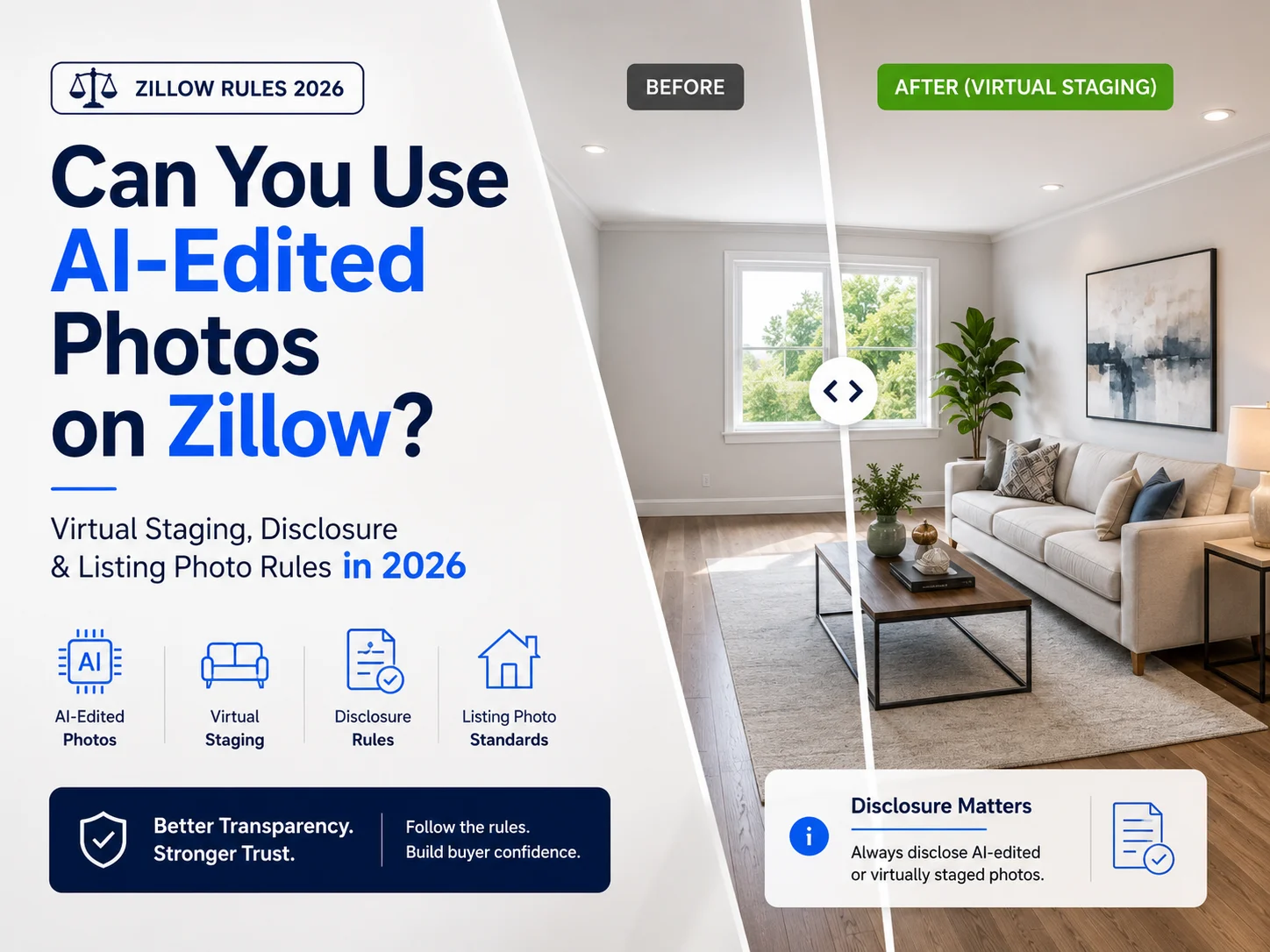
AI is rapidly changing how real estate photos are prepared, enhanced, staged, and marketed online.
Real estate agents and photographers can now use artificial intelligence to virtually stage vacant rooms, enhance listing photos, remove clutter, create Day-to-Dusk images, visualise renovations, and improve exterior presentation in a fraction of the time these workflows traditionally required.
But that creates an increasingly important question:
Can you use AI-edited real estate photos on Zillow — and where is the line between enhancement and misrepresentation?
The short answer is that AI-assisted imagery can be part of modern real estate marketing, and Zillow itself has introduced AI-powered Virtual Staging through Zillow Showcase.
But using AI does not eliminate the responsibility to represent a property accurately.
In 2026, disclosure, transparency, architecture preservation, original-image access, and human review are becoming just as important as the quality of the AI-generated result.
For agents, photographers, brokerages, and real estate media companies, understanding that distinction is essential.
Does Zillow Use AI Virtual Staging?
Yes.
Zillow introduced AI-powered Virtual Staging directly into Zillow Showcase, its premium listing experience.
The feature allows home shoppers to select different interior styles and see how certain rooms could look with alternative furniture and décor.
Buyers can explore styles such as modern, Scandinavian, industrial, midcentury, luxury, coastal, and farmhouse.
They can also compare the transformed space with the underlying listing imagery.
This is significant for the broader real estate industry.
AI virtual staging is no longer simply a specialist tool used behind the scenes by photographers.
It is becoming part of the consumer property-search experience itself.
For agents and photographers, the lesson is straightforward:
AI-edited property imagery is becoming mainstream — but transparency has to grow with it.
Can You Use AI-Edited Photos for Zillow Listings?
The better question is not simply whether AI touched the image.
It is:
What did AI change?
There is a major difference between improving the presentation of a photograph and changing material characteristics of the property.
Consider these two examples.
Standard Real Estate Photo Enhancement
A photographer may improve:
- Exposure
- White balance
- Colour balance
- Sharpness
- Perspective
- Straightening
- Overall image presentation
These are traditional real estate photography adjustments.
The objective is to make the photograph communicate the existing property more accurately and professionally.
Generative AI Property Modification
AI may also be used to:
- Add furniture
- Remove furniture
- Remove clutter
- Change décor
- Visualise renovations
- Replace landscaping
- Modify exterior elements
- Change finishes
- Create seasonal transformations
These changes go beyond ordinary photographic correction.
That does not automatically make them inappropriate.
But they require considerably more attention to accuracy and disclosure.
AI Enhancement Is Not the Same as AI Virtual Staging
This distinction is particularly important for real estate professionals.
AI Image Enhancement is intended to improve how an existing photograph is presented.
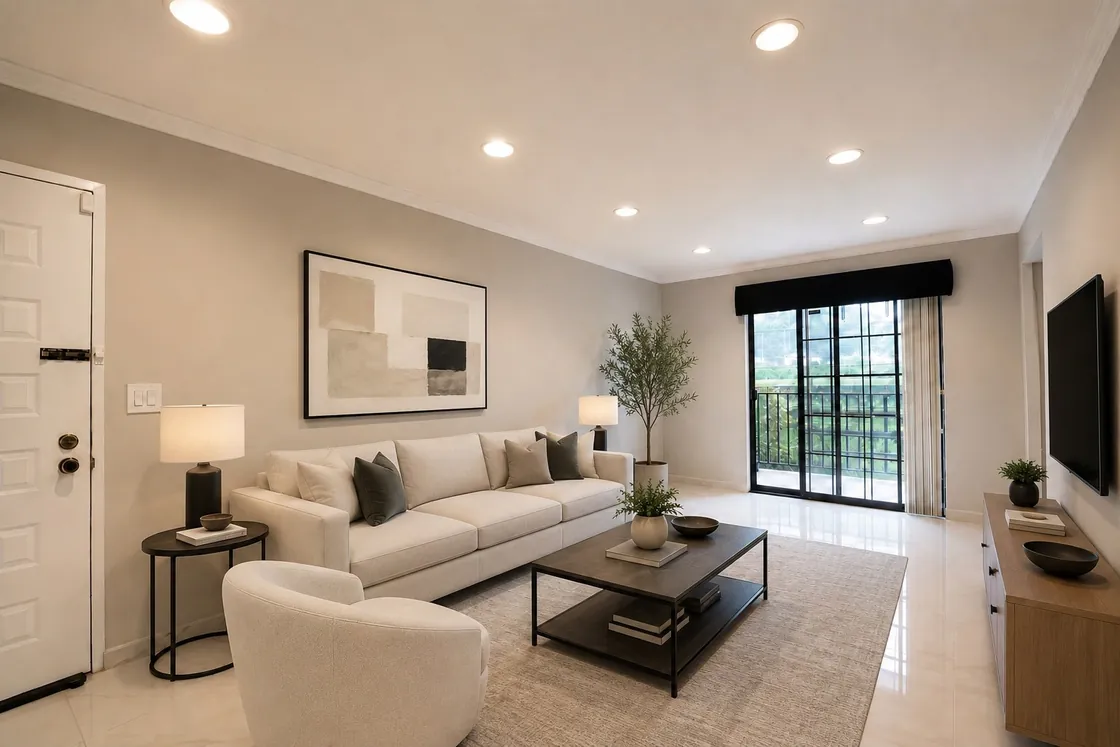
AI Virtual Staging, by contrast, introduces furniture and décor to help buyers visualise how a vacant space might function.
Virtual Renovation goes further by visualising potential improvements to an existing property.
These services have different purposes.
They should therefore not automatically be treated as the same type of modification.
A useful way to think about it is:
Enhancement → Improve the photograph
Virtual Staging → Visualise furnishing
Virtual Renovation → Visualise potential change
Understanding which category an image belongs to makes appropriate review and disclosure much easier.
What Should AI Never Misrepresent in a Listing Photo?
This is where responsible AI real estate photography becomes particularly important.
Generative AI can create extremely convincing imagery.
But a convincing image is not automatically an accurate listing image.
Unless the purpose is clearly disclosed as conceptual or renovation visualisation, AI should not quietly make a property appear structurally different from reality.
Potentially problematic changes can include:
- Moving windows
- Adding windows that do not exist
- Removing doors
- Inventing doorways
- Changing room dimensions
- Removing permanent structural elements
- Adding fireplaces
- Inventing built-in cabinetry
- Adding amenities that do not exist
- Significantly changing the view outside a property
- Making a room appear materially larger than it is
The guiding principle should be simple:
Improve the presentation without changing the truth of the property.
Why Architecture Preservation Matters
Architecture preservation is one of the most important principles behind professional AI property imagery.
For example, when EstateAI AI Virtual Staging processes a vacant room, the intended creative layer is primarily the furniture and décor.
Important property characteristics should remain recognisable, including:
- Walls
- Windows
- Doors
- Flooring
- Ceilings
- Permanent fixtures
- Room proportions
- Original camera perspective
Furniture can change.
Décor can change.
The actual property should remain recognisable.
This distinction separates professional real estate AI workflows from general-purpose AI image generation.
Zillow's Own Virtual Staging Provides an Important Clue
Zillow's approach to Virtual Staging is useful because it demonstrates how a major real estate platform thinks about AI-generated property presentation.
Its Showcase experience allows buyers to interact with virtually staged versions while still being able to compare the transformation with the property imagery.
That original-versus-generated relationship is important.
It helps buyers distinguish between:
What exists now
and
What is being visualised
That concept should extend beyond Zillow itself.
Agents, photographers, and property marketers using independent AI real estate tools should consider maintaining original photographs alongside significantly modified versions whenever appropriate or required.
Do AI-Edited Real Estate Photos Need Disclosure?
This is increasingly dependent on what was changed, where the property is located, applicable law, MLS rules, brokerage policies, advertising requirements, and the platform where the image is published.
There is no responsible universal answer that says every AI edit everywhere should be treated identically.
However, the regulatory direction is becoming clearer.
California's 2026 Digitally Altered Image Requirements
California provides an important example.
For covered real estate advertising, state law requires disclosure when qualifying digitally altered images are used.
The law defines digitally altered images broadly enough to include changes made through photo-editing software or AI that add, remove, or change elements such as:
- Furniture
- Appliances
- Flooring
- Walls
- Paint colour
- Hardscape
- Landscaping
- Facades
- Elements visible outside the property
For covered online advertising, access to the original unaltered image is also required.
Importantly, the law distinguishes these changes from ordinary photographic adjustments such as lighting, sharpening, white balance, colour correction, straightening, cropping, and exposure when those adjustments do not change the representation of the real property.
For agents and photographers, the broader lesson is important even outside California:
The difference between photographic correction and property alteration increasingly matters.
Always check the requirements that apply to the specific property, jurisdiction, MLS, brokerage, and advertising channel.
Original vs. AI-Edited Photos: A Better Workflow
Keeping the original photograph is good practice for more than regulatory reasons.
It also improves production.
A professional property workflow can maintain:
Original Photo → AI Service → Generated Version → Human Review → Approved Version → Delivery
This makes it easier to:
- Compare before and after
- Check architectural consistency
- Identify AI mistakes
- Provide disclosure where required
- Review client revisions
- Maintain quality control
- Choose the strongest result
- Retain an accurate source record
This philosophy is also central to the property-first workflow behind EstateAI.
Instead of treating every generated image as an unrelated file, originals and processed versions can remain connected to the property.
For agents and photographers using AI-assisted imagery, a professional workflow can be surprisingly straightforward.
1. Start With Strong Source Photography
AI cannot fully compensate for poor real estate photography.
Begin with:
- Good composition
- Straight verticals
- Appropriate exposure
- Accurate perspective
- Useful room coverage
- Sufficient resolution
Correct the fundamentals before applying more significant AI modifications.
EstateAI Image Enhancement can help prepare listing imagery while maintaining a preservation-oriented approach.
3. Select the Correct AI Service
Don't use one generic prompt for every real estate problem.
Different requirements need different workflows.
For example:
- AI Virtual Staging — furnish vacant spaces
- Virtual Declutter — reduce appropriate temporary clutter
- Interior Redesign — explore alternative interior concepts
- Virtual Renovation — visualise potential improvements
- Day to Dusk — create twilight-style presentation
- Exterior Cleanup — reduce appropriate exterior distractions
4. Compare Against the Original
Before publishing, look at both versions side by side.
Ask:
Did AI change anything it wasn't supposed to change?
5. Review Architectural Details
Check windows, doors, walls, flooring, fixtures, room proportions, and other permanent characteristics.
6. Disclose Significant Alterations Where Required
Follow applicable laws, MLS policies, brokerage requirements, and advertising standards.
7. Escalate Difficult Images to a Human
If the result requires precise judgement or detailed manual correction, don't force AI to solve the problem.
Use professional editing.
AI vs. Human Real Estate Photo Editing
The future of real estate image production is unlikely to be purely AI or purely manual.
A hybrid workflow makes more sense.
AI Works Well for Repeatable Production
AI can accelerate suitable workflows such as:
- Enhancement
- Virtual staging
- Decluttering
- Day-to-Dusk
- Interior concepts
- Seasonal transformations
- Exterior cleanup
Humans Remain Important for Precision
Professional editors are valuable when an image involves:
- Complex object removal
- Difficult architecture
- Exact masking
- Premium finishing
- Highly specific client instructions
- Difficult source photography
- Detailed quality control
EstateAI is developed by Pixel Perfects Solutions LLC, allowing AI-powered workflows to sit alongside professional real estate visual-production expertise.
When manual work is more appropriate, users can explore Pixel Perfects professional real estate editing services.
AI for speed. Human expertise for precision.
How EstateAI Fits Into the Zillow Listing Photo Workflow
EstateAI is not Zillow, nor is it intended to replace Zillow.
They serve different parts of the real estate ecosystem.
Zillow is a property marketplace and consumer home-search platform.
EstateAI by Pixel Perfects Solutions focuses on preparing and managing real estate visual media.
A photographer or agent might therefore use EstateAI before final media reaches a listing platform.
A simplified workflow could look like this:
Property Photography → EstateAI → Review & Approval → MLS / Brokerage / Zillow / Marketing Channels
Inside EstateAI, users can organise a property and apply multiple image workflows without treating every photograph as an unrelated generation.
That includes:
The idea is:
One property. One intelligent workspace.
Why This Matters More as Zillow Becomes More AI-Powered
Zillow's own evolution provides useful context for the broader market.
The company has expanded AI across property discovery and presentation, including conversational home search, immersive media, and AI-powered Virtual Staging.
That means consumers will increasingly encounter AI during the housing journey.
But more AI also increases the importance of trust.
Zillow itself has publicly discussed the importance of human judgement and safeguards in housing AI.
For real estate professionals, this creates an opportunity.
The winning strategy is unlikely to be:
Use as much AI as possible.
A better strategy is:
Use AI where it improves the workflow, preserve the truth of the property, verify the result, and be transparent about meaningful modifications.
AI-Edited Listing Photos: What Agents Should Remember
Before publishing an AI-modified property photograph, ask five questions:
1. Does this still represent the actual property?
2. Did AI alter any permanent architectural characteristics?
3. Is the modification obvious enough that disclosure may be appropriate or required?
4. Do I still have the original photograph?
5. Has someone actually reviewed the generated result?
If the answer to any of those questions creates uncertainty, review the image again before publishing.
Generating the image is only one part of professional real estate marketing.
Quality control is the other.
Final Thoughts
The question in 2026 is no longer simply whether AI can edit real estate photos.
It clearly can.
The more important question is:
How can real estate professionals use AI without losing accuracy, transparency, or buyer trust?
Zillow's adoption of AI-powered Virtual Staging shows how quickly AI-assisted property imagery is moving into mainstream real estate marketing.
At the same time, new disclosure requirements and growing attention around AI-generated listing photos show why professional workflows need more than impressive generation.
They need:
Accurate source photography.
Architecture preservation.
Original-image retention.
Appropriate disclosure.
Human review.
Professional quality control.
That is the philosophy behind EstateAI by Pixel Perfects Solutions.
EstateAI combines AI-powered real estate image workflows with a property-first production environment, while Pixel Perfects Solutions provides professional human expertise when a project requires more precision.
The future of AI real estate photography isn't about making fake properties look real.
It's about making real properties easier to understand, present, and market — without losing sight of what is actually there.
Create Listing-Ready Property Images With EstateAI
Prepare property media with AI-powered Virtual Staging, Image Enhancement, Decluttering, Day-to-Dusk, Virtual Renovation, Interior Redesign, Exterior Cleanup, and more.
Need professional human