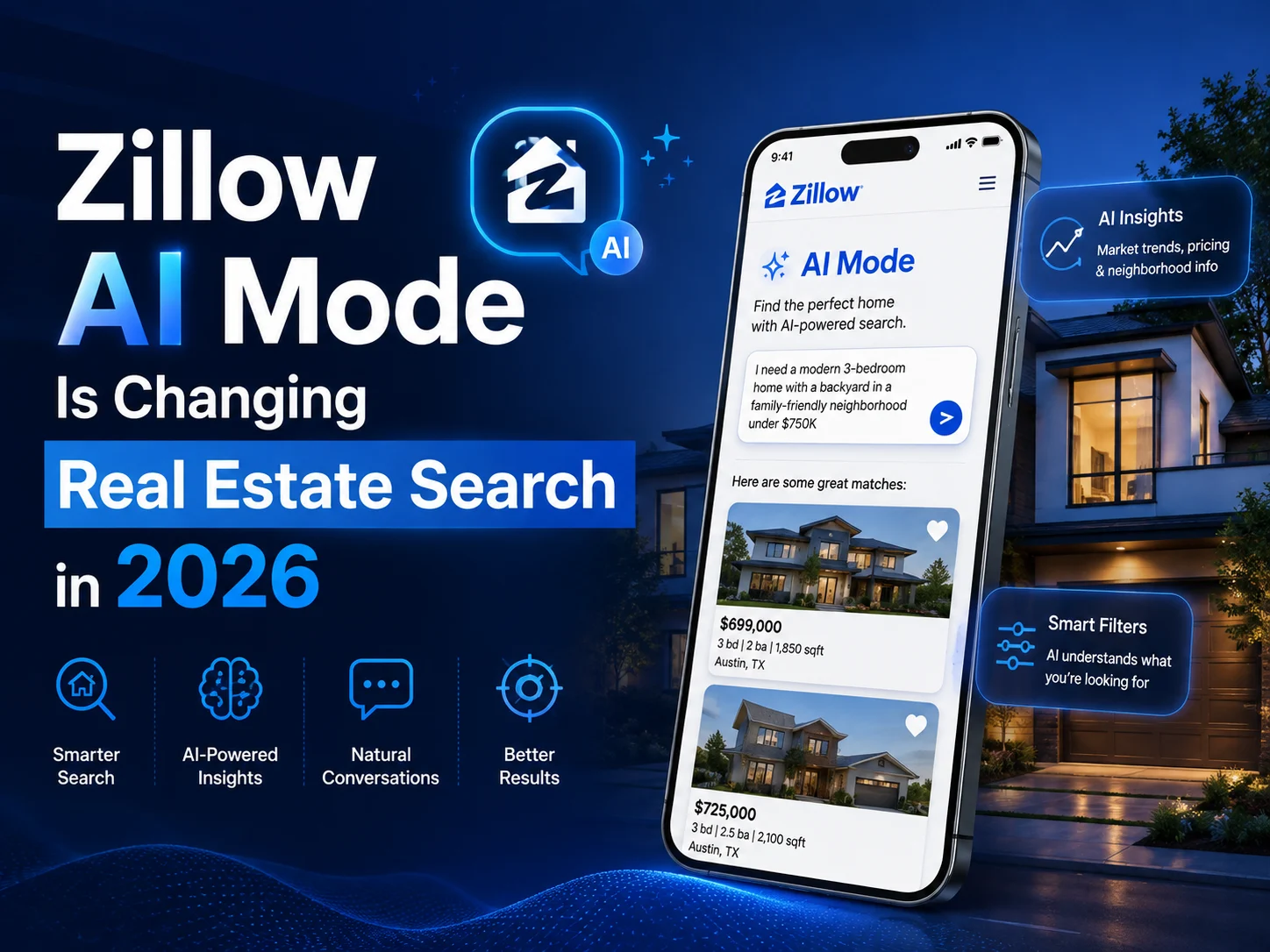
Zillow AI Mode Is Changing Real Estate Search in 2026
Home search is becoming conversational. Zillow AI Mode, ChatGPT and Google Gemini show how buyers and renters may increasingly move from natural-language questions to property discovery, tours and professional connections.
EstateAI Editorial TeamAugust 23, 2026Updated August 24, 202611 min readShare
Zillow AI Mode Is Changing Real Estate Search in 2026: What Agents and Marketers Need to Know
For years, searching for a home online followed a familiar pattern: choose a city, enter a price range, select bedrooms and bathrooms, add a few filters and start scrolling.
That experience is beginning to change.
When Zillow introduced AI Mode in March 2026, it pushed property search further toward natural conversation. Instead of translating every preference into a checkbox or dropdown, buyers and renters can describe what they want in everyday language and receive guidance built around live housing information and practical next steps such as scheduling a tour or connecting with an agent.
This matters beyond one Zillow feature. It reflects a wider change in online discovery: people are becoming more comfortable explaining an outcome to AI and letting the technology help them find the right path.
For agents, photographers, brokerages and property marketers, that creates a new question. If AI changes how a buyer reaches a listing, what needs to change about the way that listing is marketed?
From Search Filters to Buyer Intent
Traditional real estate filters are excellent at handling structured facts. They understand three bedrooms, two bathrooms, a $600,000 maximum price and a specific ZIP code.
People rarely think about their next home in such tidy database fields.
A buyer may actually be looking for a bright three-bedroom property with enough space for a home office, a fenced backyard for a dog and a commute that still makes sense three days a week.
AI-edited real estate photos are becoming mainstream, with Zillow itself introducing AI-powered Virtual Staging through Showcase. But where is the line between enhancement and misrepresentation? Learn what agents and photographers should know about Zillow virtual staging, AI listing photos, disclosure, architecture preservation, original-image access, and human review in 2026.
Zillow AI Mode Is Changing Real Estate Search in 2026
A renter may care about a pet-friendly one-bedroom, secure parking, natural light and a tour appointment available this weekend.
These are not just filters. They are expressions of intent.
Conversational AI can interpret several of those needs at the same time and allow the search to evolve naturally. A shopper can start broad, see results, explain what feels wrong and refine the request without rebuilding a filter panel from scratch.
That does not make structured property data less important. In many ways, it makes accurate data even more valuable. An AI system can only make useful connections when the information behind the listing is clear enough to understand.
For marketers, the implication is simple: complete property information, accurate descriptions and well-presented media become part of the same discovery system.
Zillow Is Expanding Beyond Zillow.com
The bigger story is that Zillow is not keeping conversational property discovery inside its own website.
In October 2025, Zillow launched a real estate experience inside ChatGPT. Users could ask housing questions conversationally and see current Zillow listings with photos, maps, pricing and property details before moving into Zillow for actions such as scheduling a tour, connecting with an agent or exploring financing.
That created a different kind of entry point into the housing journey.
A person researching relocation, affordability or neighborhoods inside an AI assistant could move from the conversation directly toward live real estate inventory instead of opening a separate property portal first.
Zillow expanded the idea again in July 2026 when Zillow Rentals became available through Google Gemini. A renter can ask Gemini for apartments matching specific needs and, when the Zillow connected experience is used, see matching rentals and real-time tour availability.
The important trend is not ChatGPT versus Gemini.
It is that the beginning of the real estate journey is becoming less tied to a single website.
A consumer might start with Google, ChatGPT, Gemini, Zillow AI Mode, social content or another AI-powered discovery system. The boundaries between search engine, assistant, real estate portal and marketplace are becoming less obvious.
AI Search Does Not Make Property Presentation Less Important
It might be tempting to assume that smarter search reduces the importance of photography.
The opposite may be true.
AI can help a buyer discover a relevant property, but eventually that person still sees the listing.
At that point, the fundamentals of property marketing have not disappeared.
If anything, better discovery could mean that a listing reaches a more relevant shopper earlier. Once it earns that attention, the media needs to justify the click.
A dark interior with poor white balance can still make a good property feel uninviting. Temporary clutter can distract from room size. An empty room may leave some buyers struggling to understand how furniture will fit. A flat daytime exterior may not have the same marketing impact as a carefully prepared hero image.
The objective is not to make a property fictional.
It is to present the real property clearly and professionally.
The New Competition May Be for AI Attention
Traditional real estate SEO has usually focused on search-engine visibility.
Agents create neighborhood pages. Photographers optimize service pages. Brokerages compete for local searches. Property technology companies publish educational content around their products.
Those strategies still matter.
But there is now another layer.
Consumers increasingly ask AI assistants questions such as:
“Who is a good listing agent near me?”
“What is the best way to market an empty house?”
“Should I virtually stage my listing?”
“What can I do to make my Zillow photos look better?”
A better way to think about it is that useful content now has more places where it may create visibility.
SEO and GEO Have More in Common Than People Think
There is plenty of new terminology around AI search, but the practical fundamentals are surprisingly familiar.
A business still benefits from publishing helpful original content. Its services should be clearly explained. Its brand information should be consistent. Relevant pages should link logically to each other. Claims should be supported where appropriate. The website should make it easy to understand who the business serves and what problems it solves.
Those practices help conventional search engines, visitors and AI systems interpret the same site.
For example, an isolated page saying “we use AI” provides very little context.
A connected group of useful pages explaining virtual staging, photo enhancement, listing-photo accuracy, Zillow disclosure, property workflows and real estate AI gives search systems far more information about the site's actual expertise.
That is one reason EstateAI is building content around related topics instead of publishing disconnected articles.
The purpose of virtual staging for real estate should be to help buyers understand how a vacant room might function—not to redesign the architecture.
That distinction becomes more important as generative tools become more realistic.
AI Search Makes Accuracy More Important, Not Less
There is another side to AI-powered property marketing.
The same technology that can improve a listing can also make it easier to misrepresent one.
An AI system can potentially add landscaping that is not there, remove permanent property features, change materials, enlarge openings or generate other modifications that make a home appear different from reality.
In July 2026, Zillow published its position on AI-generated listing photos and transparency. Zillow said listing imagery should accurately represent the home and supported clear disclosure when AI materially alters a listing image.
That is an important direction for the industry.
AI should help buyers understand a property—not make it harder to know what is real.
For agents and photographers, the safest working principle is straightforward: improve presentation while preserving the permanent property, keep original images available and follow the disclosure requirements that apply to the listing's MLS, platform and jurisdiction.
This Is Also a Workflow Problem
As AI becomes part of more property-marketing tasks, another problem appears: fragmentation.
A photographer might enhance the full shoot in one application, virtually stage three images somewhere else, create a twilight exterior using another tool and then manage the final files in a separate delivery system.
The results may look good, but the workflow becomes harder to manage.
The original image gets separated from its edited versions. Multiple files are downloaded and renamed. The same property is uploaded repeatedly. It becomes harder to know which version was approved.
The complete shoot can remain connected to the same property record while specialized AI services, generated versions, job status, review and delivery stay within the wider workflow.
As AI search becomes more sophisticated, that organization matters because the quality of the final listing still depends on the work that happens before the property reaches the buyer.
What Agents Should Do Now
There is no reason to rebuild an entire marketing strategy around Zillow AI Mode.
The smarter response is to strengthen the fundamentals that work across conventional search, AI discovery and property portals.
Make Property Information Specific
Avoid relying only on generic sales language. If a property has a useful office, oversized pantry, covered patio, accessible first-floor bedroom or flexible bonus room, communicate it clearly and accurately.
Improve the Listing Media
Use strong photography and correct obvious presentation problems before publishing. If the originals need work, professional enhancement can improve the viewing experience without redesigning the home.
Use Visualization Selectively
Virtual staging can help a buyer understand an empty room, but it should remain believable and clearly treated as visualization where required.
Publish Helpful Content
Agents and real estate businesses should answer the questions consumers actually ask instead of producing pages built only around keywords.
Build Clear Topical Relationships
A strong article about virtual staging should connect naturally to related content about disclosure, photography, property marketing and the relevant service itself.
Keep Brand Information Consistent
Your website, business profiles, social accounts and industry listings should make the basic facts about your business easy to verify.
Watch AI Discovery Alongside Google Search
Track where prospects are coming from. AI platforms may become another discovery channel, but they should be measured rather than assumed.
What Real Estate Photographers Should Do
Photographers have a slightly different opportunity.
As search becomes smarter, agents still need high-quality visual assets to compete after their listings are discovered.
That keeps real estate photography central to property marketing.
The opportunity is to make production faster without sacrificing standards.
Instead of moving a property between several unrelated processing tools, photographers can use a property-first platform to keep originals, treatments and outputs connected.
For an empty hero room, AI Virtual Staging may help the buyer understand scale and use.
Temporary distractions may be better handled with Virtual Declutter.
A strong exterior can be prepared as a premium twilight presentation using Day to Dusk.
The important part is choosing the right treatment instead of applying generative changes simply because the technology exists.
What This Means for Real Estate Marketing in 2026
Zillow AI Mode is important, but it is not the whole story.
The broader shift is toward intent-based discovery.
People increasingly expect technology to understand what they are trying to accomplish rather than forcing them to learn how every system is organized.
That change is already visible across search, SaaS and real estate.
For property marketing, the winning response is not to chase every new AI product.
It is to make your content, property information and visual presentation easier to understand wherever discovery happens.
That includes traditional Google search.
It includes Zillow.
It includes AI assistants.
Increasingly, it includes combinations of all three.
What Happens Next?
Conversational property search is still developing.
Traditional filters will not suddenly disappear, and real estate portals will remain important. Many users prefer direct control, especially once they know exactly what they are looking for.
But conversational AI adds another layer to the experience.
It can help people begin with a messy human question instead of a perfectly structured search.
That is valuable because buying or renting a home has never been a perfectly structured decision.
People balance price, location, lifestyle, commute, space, timing, financing and emotion all at once.
The technology is getting better at understanding that complexity.
Real estate professionals should focus on making sure that when AI helps a consumer discover a property, the listing waiting at the other end is accurate, useful and professionally presented.
AI can change the path to the listing.
It does not change the need for trust once the buyer gets there.
Zillow AI Mode is a conversational housing-search experience launched in 2026. It allows buyers and renters to describe what they want naturally, explore relevant housing information and move toward actions such as scheduling tours or connecting with an agent.
When did Zillow AI Mode launch?+
Zillow announced AI Mode in March 2026 as a conversational experience designed to provide more personalized guidance throughout the housing journey.
Can buyers search for homes on Zillow using normal language?+
Yes. Zillow AI Mode is designed to interpret conversational housing requests instead of requiring users to express every preference through traditional filters.
Can people find Zillow listings through ChatGPT?+
Yes. Zillow launched a real estate experience inside ChatGPT that can surface current property listings and direct users toward Zillow for additional actions.
Does Zillow work with Google Gemini?+
Yes. Zillow Rentals became available through Google Gemini in 2026, allowing renters to discover matching properties and available tour times.
Will AI search replace Zillow's normal filters?+
Probably not. Conversational search is more likely to complement traditional filters, giving consumers another way to begin and refine their property search.
What does Zillow AI Mode mean for real estate agents?+
It creates another potential discovery route for buyers and renters. Agents should continue focusing on accurate property data, high-quality media, useful online content and a clear digital presence.
Are AI-edited photos allowed on Zillow?+
AI editing is not simply a yes-or-no issue. Listing imagery should accurately represent the property, and disclosure requirements may depend on the type of alteration, MLS rules, platform policies and local regulations.
What is GEO for real estate?+
Generative Engine Optimization, or GEO, focuses on making a real estate business, brand and its expertise easier for AI-powered systems such as ChatGPT, Gemini and other generative search platforms to understand and reference.
How can EstateAI help with property marketing?+
EstateAI by Pixel Perfects Solutions provides a property-first workspace where photographers, agents and real estate teams can upload a shoot, apply specialized AI services, review connected versions and prepare client-ready property media.
EstateAI
Turn the next property into a complete marketing workflow.
Upload once. Analyze, enhance, stage, review, market, share and deliver from one connected Property Workspace.