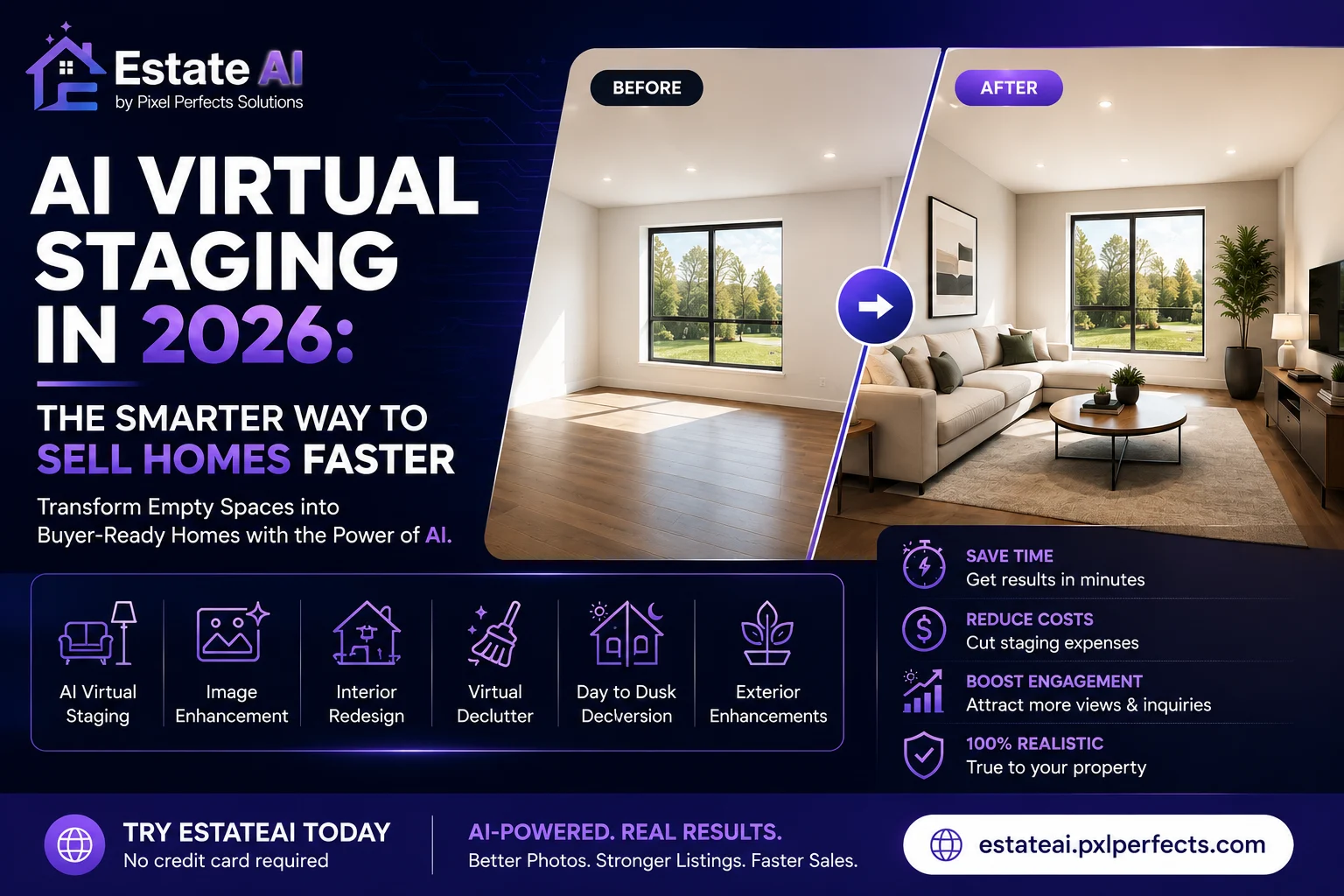
AI Virtual Staging in 2026: The Smarter Way to Market Homes
Discover how AI virtual staging is helping real estate agents, photographers, and brokers transform empty property photos into buyer-ready listings in minutes while saving time, reducing costs, and increasing engagement.
EstateAI Editorial TeamAugust 8, 2026Updated August 11, 202612 min readShare
AI Virtual Staging in 2026: The Smarter Way to Sell Homes Faster
Real estate marketing is becoming increasingly digital. Before scheduling a showing, many buyers first discover a property through listing websites, search engines, social media, and online marketplaces. That makes the quality of property photos one of the most important parts of a successful listing.
But marketing an empty property can be challenging.
Vacant rooms can look cold, unfinished, or difficult to visualize. Buyers may struggle to understand how furniture would fit, how a room could be used, or what the property might feel like as a finished home.
Traditional home staging can solve this problem, but it often involves furniture rentals, delivery, setup, storage, removal, and scheduling. For agents managing multiple properties, these costs and logistics can quickly become difficult to manage.
AI virtual staging offers a smarter and more flexible alternative.
With AI-powered technology, real estate professionals can transform empty property photos into realistic furnished scenes in minutes. Instead of physically bringing furniture into a property, AI can digitally add furniture, décor, and interior design elements while maintaining the room's existing structure and perspective.
EstateAI is built specifically for this modern real estate workflow, helping agents, brokers, photographers, developers, and property marketers create professional property visuals faster.
Try EstateAI for AI-powered virtual staging
What Is AI Virtual Staging?
AI virtual staging is the process of using artificial intelligence to digitally furnish and decorate empty or unfurnished property photographs.
The technology analyzes the room and its visual characteristics before generating furniture, décor, and other design elements that fit the available space.
AI listing videos are changing real estate marketing in 2026—but what happens when AI invents windows, walls, layouts, or property features that do not exist? Explore the risks of AI-generated real estate videos, virtual staging accuracy, AI-edited listing photos, Zillow Showcase video requirements, disclosure, architecture preservation, and how agents and photographers can build more accurate, transparent property-media workflows.
Excerpt: Empty rooms don't sell homes. See why AI virtual staging has become standard in real estate marketing, how it actually works, and how EstateAI turns a single photo shoot into a complete, listing-ready property package without the fake, floating-furniture look of older staging tools.
AI Virtual Staging in 2026: The Smarter Way to Market H…
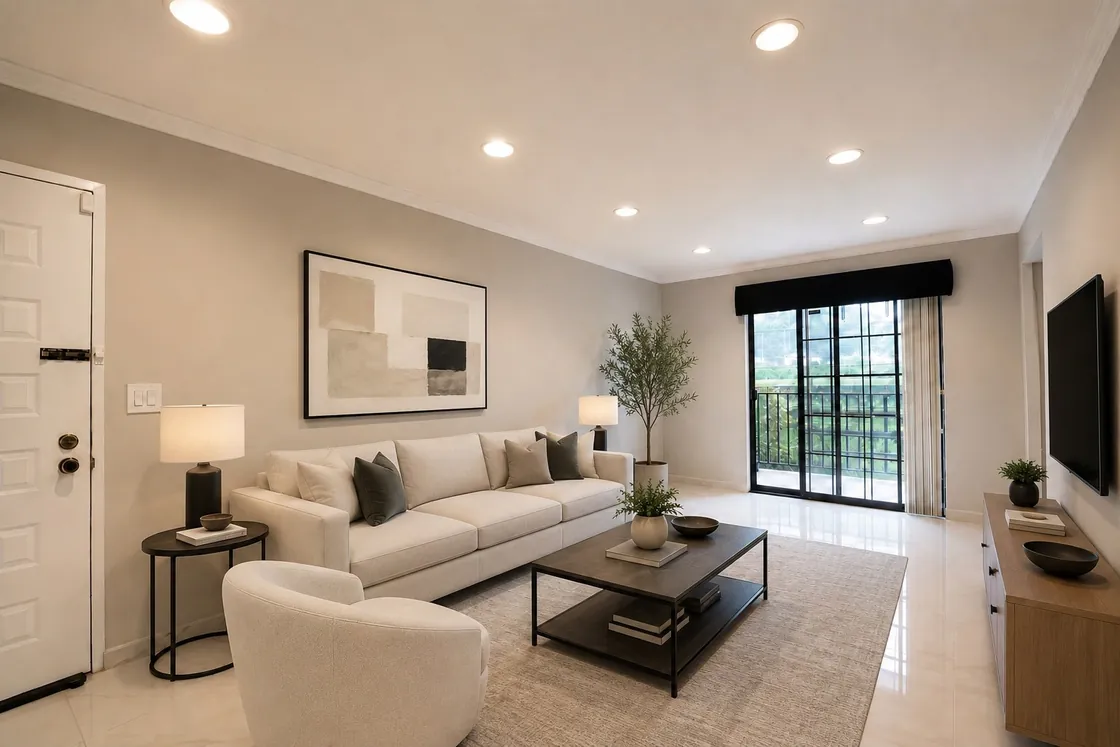
For example, an empty living room can be transformed into a furnished space with a sofa, coffee table, rug, lighting, artwork, and decorative elements. A vacant bedroom can be presented with a bed, nightstands, lighting, and complementary décor.
The actual property does not physically change. Instead, the photograph is digitally enhanced to help potential buyers understand the room's possibilities.
AI virtual staging can be especially useful for:
Vacant homes
Apartments and condos
Rental properties
New construction
Investment properties
Model homes
Unfurnished rooms
Properties being marketed remotely
The goal is simple: help buyers visualize the potential of a property before they visit it in person.
Why AI Virtual Staging Matters for Real Estate Marketing
Online property listings compete for attention every day. Buyers can scroll through dozens of properties within minutes, making strong visual presentation increasingly important.
A vacant room may provide an accurate representation of the property, but it does not always communicate how the space could be used.
AI virtual staging adds visual context without requiring physical furniture.
Make Vacant Properties Easier to Visualize
One of the biggest benefits of virtual staging is visualization.
A completely empty room can make it difficult to understand its scale and purpose. Adding appropriately sized furniture gives potential buyers a clearer idea of how the space could function.
A staged living room can demonstrate where seating could go. A virtually staged bedroom can show how much furniture the room can accommodate. A dining area can be presented with a table and chairs to communicate its intended purpose.
This makes the listing easier to understand without physically changing the property.
Create Listing Images Faster
Traditional staging requires coordination.
Furniture needs to be selected, transported, installed, and eventually removed. Scheduling can become even more complicated when agents manage multiple listings.
AI virtual staging reduces much of this physical preparation by allowing digital staging to happen directly from property photographs.
This can help real estate professionals prepare marketing assets more efficiently.
Reduce Physical Staging Requirements
Physical staging can be valuable, but it is not always practical.
Virtual staging eliminates the need for physical furniture rentals, transportation, installation, and storage for the digitally staged image.
This can make it particularly useful for:
Remote properties
Vacant properties
Investment properties
Rental listings
Properties in different markets
Large property portfolios
Create Multiple Design Concepts
Different properties appeal to different audiences.
With AI virtual staging, professionals can explore multiple interior design styles without physically redesigning the room.
For example, the same living room could be presented as:
Modern
Luxury
Scandinavian
Minimalist
Contemporary
Farmhouse
Industrial
Coastal
Rustic
Boho
This gives agents and marketers more flexibility when developing property marketing campaigns.
How EstateAI Helps Real Estate Professionals
EstateAI is an AI-powered property visualization platform designed around the needs of real estate professionals.
Instead of relying on separate tools for every property image task, EstateAI brings multiple AI-powered features into one workflow.
AI Virtual Staging
EstateAI can transform empty rooms into realistic furnished spaces using AI-powered virtual staging.
Agents can choose different interior design styles to create visuals that complement the property and its target audience.
The objective is to make empty spaces easier for potential buyers to visualize while maintaining the property's important architectural characteristics.
Interior Redesign
Not every property is completely empty.
Sometimes a room already contains furniture but has an outdated or unattractive design.
Interior redesign allows professionals to visualize a different style by updating furniture and décor while retaining the underlying room structure.
This can be useful when marketing older properties or demonstrating alternative design possibilities.
Virtual Renovation
Renovation projects can be difficult to visualize from empty or outdated photographs.
Virtual renovation can help show potential design changes before physical work begins.
For example, professionals can use digital visualization to demonstrate how a room might look after a design update.
This can be particularly useful for property investors, developers, renovation professionals, and real estate marketers.
Virtual Decluttering
Clutter can distract potential buyers from the actual property.
Virtual decluttering helps create cleaner property photographs by digitally removing unwanted objects and visual distractions.
This can be useful for occupied homes, rental properties, and listings that need a cleaner visual presentation.
Day-to-Dusk Conversion
Exterior photography can be presented in different lighting conditions using AI-powered image transformation.
Day-to-dusk conversion can create an attractive evening-style presentation that gives agents another option for showcasing a property's exterior.
AI Image Enhancement
Property photography sometimes needs additional enhancement before it is ready for marketing.
AI image enhancement can help improve the overall visual presentation of property photos while maintaining the important characteristics of the original image.
Better-looking images can contribute to a more professional listing presentation across websites, social media, and other marketing channels.
Exterior Landscaping
The exterior of a property can be just as important as its interior.
AI-powered landscaping visualization can help show potential improvements to outdoor areas such as yards, gardens, and surrounding spaces.
This gives buyers another way to visualize a property's potential.
Pool Opening
Properties with pools can benefit from digitally enhanced outdoor presentation.
Pool-related visualization can help create more attractive marketing images when an outdoor pool area needs to be presented in a cleaner or more marketable way.
Snow Removal and Exterior Cleanup
Seasonal conditions and outdoor clutter can affect property photography.
AI-powered exterior cleanup tools can help create cleaner marketing visuals by removing unwanted visual distractions where appropriate.
AI Virtual Staging vs. Traditional Home Staging
AI virtual staging and traditional home staging serve similar marketing goals, but the process is very different.
Feature AI Virtual Staging Traditional Home Staging
Physical furniture Not required Required
Furniture transportation Not required Usually required
Setup Digital Physical
Multiple design styles Easy to create Requires physical changes
Turnaround Often much faster Requires scheduling
Remote properties Highly practical More difficult
Physical buyer experience No Yes
Marketing flexibility High Depends on available furniture
Best for property photos Yes Yes
Traditional staging can still be useful when buyers need to physically experience a furnished property.
However, AI virtual staging provides a highly flexible solution when the primary goal is creating attractive online listing photography.
For many professionals, the two approaches can also complement each other.
Popular Virtual Staging Styles in 2026
Interior design preferences continue to evolve, but several styles remain popular for real estate marketing.
Modern
Modern staging focuses on clean lines, practical furniture, neutral colors, and a polished contemporary appearance.
Scandinavian
Scandinavian interiors typically emphasize simplicity, natural materials, light colors, and comfortable furniture.
Luxury
Luxury staging uses sophisticated furniture, elegant décor, layered lighting, and premium-looking finishes to create an upscale atmosphere.
Minimalist
Minimalist staging keeps furniture and décor intentionally simple, helping rooms appear clean, open, and uncluttered.
Contemporary
Contemporary staging combines current design trends with practical furniture and refined decorative elements.
Farmhouse
Farmhouse interiors often use warm colors, natural textures, comfortable furniture, and a welcoming aesthetic.
Industrial
Industrial design commonly combines modern furniture with darker finishes, exposed textures, metal elements, and practical décor.
Coastal
Coastal staging uses lighter colors, natural textures, and relaxed furniture to create a bright and comfortable atmosphere.
Who Can Benefit From AI Virtual Staging?
AI virtual staging is useful for more than just real estate agents. Several professionals involved in property marketing can benefit from AI-powered visualization.
Real Estate Agents
Agents can use virtual staging to present vacant properties more effectively and help buyers visualize empty rooms.
Real Estate Photographers
Photographers can offer virtual staging as an additional service alongside professional property photography and image editing.
Brokers and Brokerages
Brokerages managing multiple listings can use AI-powered workflows to create consistent property marketing visuals across their portfolio.
Property Developers and Home Builders
Developers can use virtual staging and interior visualization to market new construction and unfinished properties.
Property Managers
Property managers can use digitally furnished images to market vacant rental units and apartments.
Real Estate Marketing Agencies
Marketing agencies can integrate AI virtual staging into their listing photography, social media campaigns, websites, and advertising workflows.
How AI Virtual Staging Fits Into a Modern Property Marketing Workflow
A typical AI virtual staging workflow can be completed in a few simple steps.
1. Upload the Property Photo
Start with a clear photograph of the empty or existing room.
For the best results, use a high-quality image with good lighting and a clear view of the room.
2. Select the Room Type and Design Style
Choose the appropriate room type and interior design style.
For example, a living room can be staged in a modern or luxury style, while a bedroom can use a minimalist or Scandinavian design.
3. Generate the Staged Image
The AI processes the image and generates digitally furnished content based on the selected requirements.
4. Review the Result
Review furniture placement, proportions, lighting, perspective, and overall realism.
The staged image should enhance the property without creating a misleading impression of its actual structure.
5. Use the Image in Your Marketing
Once approved, the finished visual can be used as part of an appropriate property marketing campaign.
Potential channels include:
Property websites
Listing platforms
Social media
Digital advertisements
Email marketing
Property brochures
Real estate websites
Best Practices for AI Virtual Staging
AI virtual staging can produce impressive results, but quality and accuracy should always remain the priority.
Keep the Property's Structure Accurate
Walls, windows, doors, flooring, room proportions, and other important architectural elements should remain consistent with the original property.
Virtual staging should enhance the presentation rather than misrepresent the property.
Choose Furniture That Fits the Room
Furniture should be appropriately scaled to the available space.
Oversized sofas, unusually small tables, or incorrectly positioned furniture can make an image look unrealistic.
Match the Design to the Property
The interior style should complement the property's architecture and target market.
A contemporary apartment may benefit from modern staging, while a traditional home may work better with warmer or classic design elements.
Avoid Over-Staging
Too much furniture or décor can make a room appear smaller.
Good virtual staging should provide enough furniture to communicate the purpose and potential of the room while keeping the space visually open.
Use High-Quality Source Photos
The quality of the original property photograph affects the quality of the final marketing image.
Whenever possible, start with clear, well-composed, high-resolution property photography.
How AI Virtual Staging Can Support Real Estate Marketing
AI virtual staging is not simply about adding furniture to an empty room.
It can become part of a broader real estate marketing workflow.
A single property may require interior staging, image enhancement, decluttering, exterior improvements, renovation visualization, and multiple marketing variations.
Having these capabilities available within a connected workflow can help professionals manage property visuals more efficiently.
For agencies and brokerages handling multiple listings, this can also make it easier to maintain consistency across marketing materials.
The Future of AI in Real Estate Marketing
Artificial intelligence is becoming an increasingly important part of digital property marketing.
The technology is moving beyond simple image generation toward specialized workflows designed around specific industries.
In real estate, this includes:
AI virtual staging
Property image enhancement
Interior redesign
Virtual renovation
Virtual decluttering
Exterior visualization
Landscaping visualization
Automated property workflows
The future of property marketing is likely to combine professional photography, AI visualization, automation, and human creative direction.
AI does not eliminate the importance of good photography or professional marketing strategy. Instead, it gives real estate professionals additional tools for creating and adapting visual content more efficiently.
Why EstateAI Is Built for Modern Real Estate Teams
EstateAI is designed specifically around real estate property visualization.
Rather than focusing on generic AI image generation, the platform brings together multiple tools that address common property marketing needs.
From staging an empty room to enhancing an exterior image, EstateAI provides a centralized workspace for creating property marketing visuals.
This can be particularly valuable for professionals managing multiple properties and needing a repeatable visual workflow.
For many real estate professionals, AI virtual staging can be a practical addition to their marketing workflow.
It can help make vacant rooms easier to visualize, provide more design flexibility, reduce dependence on physical furniture for listing photography, and accelerate the creation of marketing visuals.
However, the effectiveness of virtual staging depends on the quality and realism of the final images.
The best results come from using appropriate furniture, accurate room proportions, realistic lighting, and high-quality source photography.
AI virtual staging should be viewed as a marketing and visualization tool, not a substitute for accurately representing the actual property.
Final Thoughts
AI virtual staging is becoming one of the most useful visual technologies for modern real estate marketing.
Instead of leaving buyers to imagine what an empty room could become, real estate professionals can use AI to create realistic visual representations of furnished spaces.
For agents, brokers, photographers, developers, property managers, and marketing agencies, this creates new opportunities to present properties more effectively across digital channels.
EstateAI takes this concept further by bringing AI virtual staging, interior redesign, virtual renovation, virtual decluttering, image enhancement, exterior visualization, and other property-focused AI tools into one platform.
The future of real estate marketing is increasingly visual, flexible, and AI-powered.
If you're ready to create more engaging property visuals and streamline your listing workflow, EstateAI gives you the tools to turn property photos into professional marketing assets faster.
AI virtual staging is the process of using artificial intelligence to digitally add furniture, décor, and interior design elements to real estate photographs. It helps potential buyers visualize how an empty room could look when furnished.
How does AI virtual staging work?+
A property photograph is analyzed by an AI-powered system, which generates furniture and décor that fit the room's visible structure, perspective, and design requirements. The resulting image can then be reviewed and used for appropriate property marketing.
Is AI virtual staging the same as traditional home staging?+
No. Traditional staging uses physical furniture inside the property, while AI virtual staging digitally adds furniture to photographs. Traditional staging can provide a physical experience, while virtual staging is particularly useful for online property marketing.
Can AI virtual staging be used for occupied homes?+
Yes. AI-powered image editing can be useful for occupied properties as well as vacant homes. For example, virtual decluttering or interior redesign can help create cleaner or alternative marketing visuals.
What types of rooms can be virtually staged?+
Common examples include living rooms, bedrooms, dining rooms, offices, kitchens, and other interior spaces. Outdoor areas can also be digitally enhanced depending on the tools available.
What design styles can be used for virtual staging?+
Popular styles include Modern, Luxury, Scandinavian, Minimalist, Contemporary, Farmhouse, Industrial, Coastal, Rustic, and Boho.
Who can benefit from AI virtual staging?+
Real estate agents, brokers, photographers, property developers, home builders, property managers, marketing agencies, and other real estate professionals can use AI virtual staging as part of their property marketing workflows.
Does virtual staging change the actual property?+
No. Virtual staging changes the digital photograph rather than physically changing the property. Important architectural features should remain accurately represented.
Is AI virtual staging expensive?+
Costs vary depending on the platform, number of images, features, and workflow requirements. Compared with physical furniture staging, digital staging can reduce some furniture rental, transportation, setup, and storage requirements.
Can EstateAI do more than virtual staging?+
Yes. EstateAI provides multiple AI-powered property visualization features, including interior redesign, virtual renovation, virtual decluttering, day-to-dusk conversion, image enhancement, exterior landscaping, pool visualization, snow removal, and exterior cleanup.
EstateAI
Turn the next property into a complete marketing workflow.
Upload once. Analyze, enhance, stage, review, market, share and deliver from one connected Property Workspace.